Non-discretionary underearning trading at dirt cheap multiples
Moro Corp (MRCR) currently offers a compelling investment opportunity at $2.10, trading at 2.8x EBIT with ample FCF generation, $0 debt, and a growing cash pile. It also offers downside protection with NCAV/share of $2.23.
Overview
Moro Corp owns 2 lines of business. They own construction material (J.M. Ahle + Whaling) and construction contract (Apollo Heating + Rondout) companies. The company was founded in 1999 by founder David Menard and acquired a couple companies, including the ones active today. Eventually, David Menard retired in 2019 and his son, Neil Kessler took over as Chairman. His son in law became President. In 2020, Neil became president and remained Chairman, while Ehud Israel became VP of Strategy. Since then, Neil has improved the company substantially and made some operational improvements that resulted in margin expansion, offsetting the decline in construction material segment revenues.
Snapshot
Price: $2.10
Market Cap: $12.9m
Shares Outstanding: 6.12m
EV: $6.25m
Construction Materials Segment
The construction materials segment has been on the decline in the past 10 years. It has been a drag in profitability as margins eroded alongside the decline in revenue. Basically, what they do is they fabricate rebar or reinforced steel, and sell it to contractors usually for roads, bridges, buildings, etc., any type of structure in NY metro areas, Eastern Pennsylvania, and New Jersey. It is a commodity business with no differentiation besides price and delivery time.
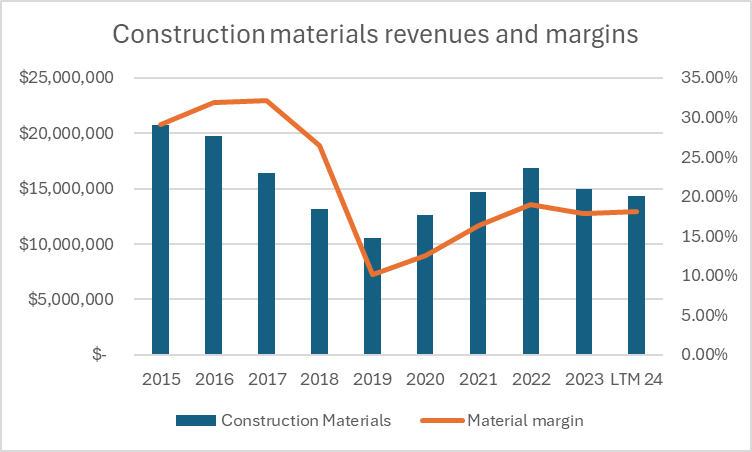
In the graph above we can see the deterioration in revenues from 2015- 2019, and then the bounce of the construction boom in 2020-2022. It has since then started to cool off as activity has slowed down. If I had to guess, management would eventually sell the division. It is hard to get to the operating margins at the division level, but I will guess it’s not very good and it’s a drag on profits.
Construction Contract Segment
The construction contract segment is basically all HVAC revenues. Apollo is one of the main players in the Capital Region of NY in the HVAC industry. They mainly focus on Residential New Construction (HVAC Install) and Retail (service and repair). HVAC companies are recession resistant as homeowner will always need someone to come repair their air or heat, it’s not something they just tell themselves that they will fix later. It’s a necessity. This is one of the main reasons PE firms go crazy over the industry. They also own Rondout which is an electrical service contractor, but information is limited for this company.
The division’s revenue is down from 10 years ago; however, they did sell some businesses that were part of that reporting segment. They also closed the commercial line of the business. I’m not sure how much commercial contributed to residential. I will be asking management.
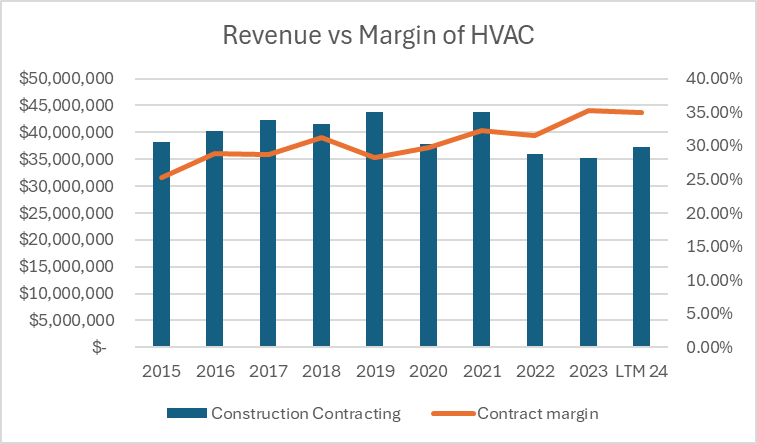
Margins for the segment have been generally on an uptrend while HVAC revenues have been kind of all over the place. 2015-2019 were strong housing years. 2020 went to the dirt and then the quick rebound in 2021 from low rates gave company tailwinds and then normalized through 2023 and recently we are seeing an uptick towards 2024.
Capital Region
The HVAC business is highly tied up to the housing market especially since their service demand is driven by Residential New Construction (RNC). The capital region is one of the strongest regions in the state of NY in terms of population growth which is good generally for housing. The Regional Economic Development Council (REDC) has stated its goals for 2024-2028. One of the main goals are new housing units of 26,600. They also have net employment gain of 20,000 and net population gain of 30,000. “Between 2010 and 2020, the region added 26,498 housing units, an increase of 5.2 percent. Only the New York City region grew faster.” During the period of 2015-2019, we saw revenues rise consistently for HVAC.
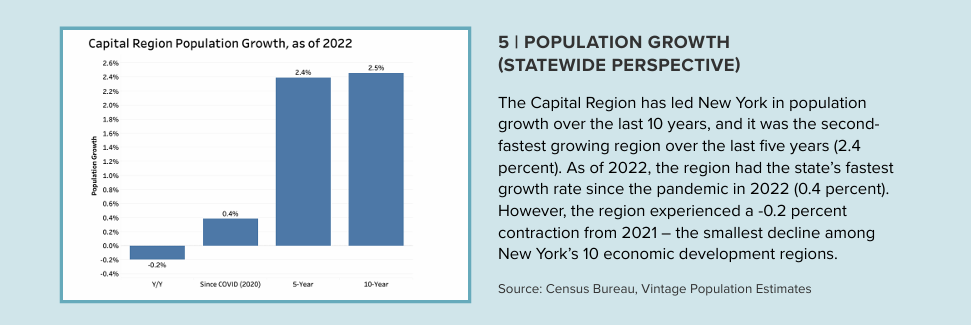
Click to access REDC%20Strategic%20Plan%202023_High%20Rez.pdf
I believe this makes the case for the Capital Region being a place where housing will be strong when the industry rebounds. Considering Appolo Heating is one of the main players in the region, they will likely do fine.
Value of Appolo Heating
I did some research and HVAC service businesses are being sold at 6x-8x EBITDA usually, maybe more. I can’t get to the exact EBITDA margin from each segment, but the average is around 10% for HVACs but Appolo is well run as we can see from the margin expansion over the last 10 years so we can safely assume it’s more than 10%, but for the sake of it let’s call it 10% margin. On 2024E revenue, that is $3.7m in EBITDA. That brings us to an acquisition price of $22m-$29.7m. Keep in mind, the market cap is $12m. They acquired Appolo in 2006 for $3.3m.
One of their competitors in Albany, NY, was acquired in early 2024 by a PE firm, however the price is undisclosed. In November, that same competitor acquired another competitor in the region. That same company announced they are looking to acquire an electrical contracting service company to expand their service line, and guess what, Rondout is owned by Moro which could lead to a potential sale of that business.
Management Capital Allocation and Changes in Operating Performance
I believe Neil Kessler has been behind the operating improvement of the company, including margin improvements at the operating level. One small example is advertising expenses. Advertising expense pre-Neil Kessler was around $500-$600k a year, it has now been cut down to around $150k/year. It seems small but just the principle of cutting costs even that small outlines his philosophy of every dollar counts.
Neil has taken the initiative to wind down operations and sell underperforming businesses. In 2022, he closed Titchener and sold J&J Sheet Metal Work. They also closed down the commercial line on the HVAC business. The reason he sold them, in his own words “The first action was the previously reported shutdown, earlier this year, of operations at its Titchener Iron Works subsidiary in Binghamton, NY, whose business was to fabricate and install stairs and railings. Since being acquired by Moro in 2010, Titchener had consistently poor performance. In addition, weak economic conditions in Titchener’s markets made the decision to close it down the best option.”
On J&J “Another recent change was the sale of Moro’s subsidiary, J&J Sheet Metal Works, LLC, located in Vestal, NY, to a partnership including J&J’s former president, who had approached Moro about the sale. Moro carefully weighed a number of factors and decided that the transaction would be a strategically advantageous way to enhance Moro’s operating results.”
On the commercial line of Appolo “The last recent strategic change at Moro was to exit from the commercial HVAC line of business operating at its Appolo Heating, Inc. subsidiary in Schenectady, NY. The line’s profitability was always limited, and it was facing continued, challenging market conditions. Management made the decision that concentrating resources in the other two lines of Appolo’s business could improve Moro’s overall operating results.”
I think his initiative of closing down underperforming businesses shows good capital allocation skills.
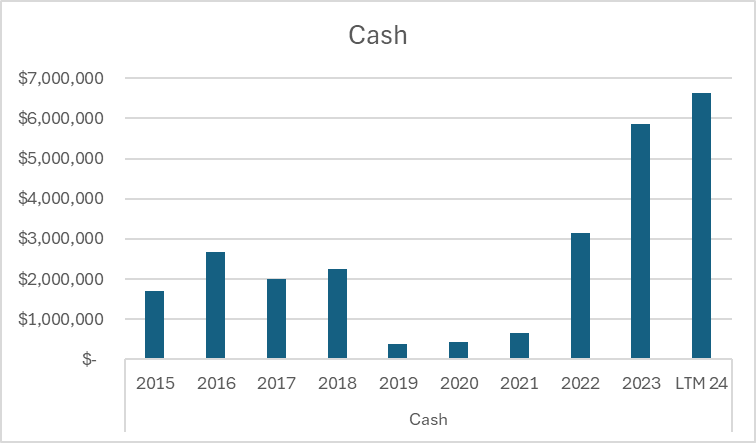
This is the company’s cash balance at the end of year. I expect at FY24 cash will reach around $8m vs a market cap of $12m or 66% of the market cap. They have $0 debt and do not need to use any type of debt to fund operations. The business does not require much cash either, which leads me to my next question.
What will management do with a growing cash pile? The most obvious answer is either buybacks or a special dividend. Even going private might be a good option if they offer shareholders a good price. However, the company has never paid a dividend which is beyond me considering the amount of cash they generate.
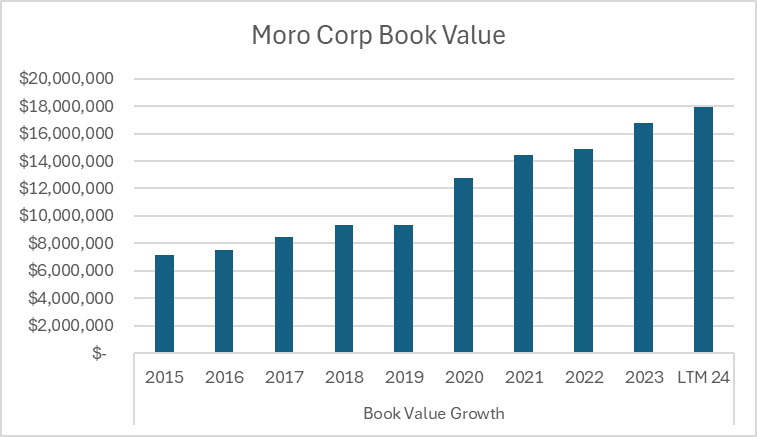
The company has grown book value consistently over the last 10 years, growing 157% over the time period and at a 9.9% CAGR. I’m confident it will keep on growing under the current management team.
Valuation
Moro is trading at 2.8x EBIT, a 35.2% yield with ample FCF generation and a growing cash balance. We have downside protection based on NCAV. Current NCAV/share is $2.23 while the stock price stands at $2.10, not a massive discount but still significant. The current price is a steal considering the value of Appolo, and on top of that, Apollo is underearning due to weakness in the housing market.
The company is a better business now than what it was before, and I think that is partly due to the new management team which is essentially Neil and Ehud. The company has gone from millions in debt to virtually $0 debt and ample FCF generation, growing the cash pile. Margins have improved throughout the years due to management disposing of weak-performing businesses and cost-cutting/price increases, and I expect that to continue.
*Disclaimer: The information provided in this write-up is for informational and educational purposes only. It should not be considered as financial advice or a recommendation to buy, sell, or hold any security. The author is not a licensed financial advisor and does not purport to provide professional investment advice. The analysis presented is based on the author’s personal research and opinions, which may be subject to errors, omissions, or changes without notice. Any investment decisions should be made after conducting your own thorough research and consulting with a qualified financial professional. The author and any associated parties are not responsible for any financial or other losses incurred based on the information provided in this document. Past performance is not indicative of future results. Always consider your personal financial situation, risk tolerance, and investment objectives before making any investment decisions.


Thanks for this write up. Did you ever ask management about the size of the commercial HVAC business? Also, do you know what percentage of HVAC revenue comes from new construction vs. maintenance service?
LikeLike