A tiny dominant bank
The Home Loan Financial Corp (HLFN)
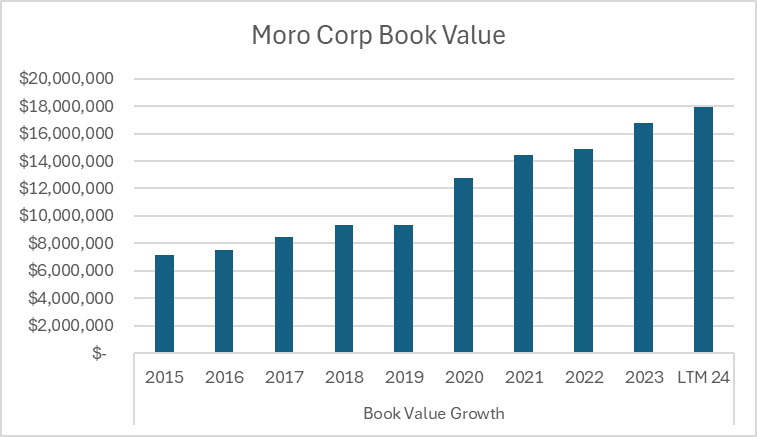
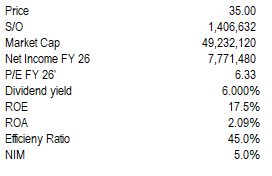
HLFN trades at ~6.3x FY 26’ earnings despite being a dominant local franchise with pricing power, with a growing core deposit base, generating high teens ROE and above-average ROA. Thanks to their significant market share in Coshocton County, they are able to maintain higher loan yields while maintaining structurally low deposit costs, contributing to a stable and above average NIM. The company has grown earnings and book value consistently, even during the recent yield inversion period in 2022-2024. I believe the bank deserves a more reasonable multiple of 10x earnings, implying a 58% upside from today’s $35 price per share.
Snapshot:
Overview
The Home Loan Savings Bank was founded in 1882 as a mutual savings and loan association. In 1998, the bank converted from mutual to stock form of ownership and began trading on the public markets as The Home Loan Financial Corp. They operate out of five branches across Licking, Knox, and Coshocton counties in Ohio. Recently, they opened a new branch in Newark, Ohio, which is a higher traffic county. The bank has ~$370m in assets as of latest quarter.
Coshocton County
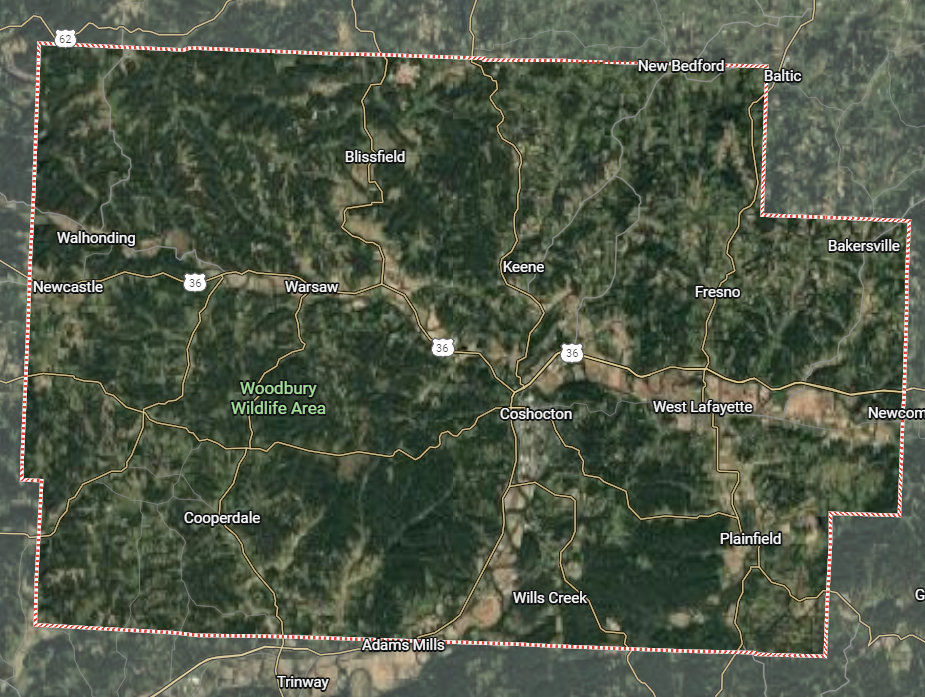
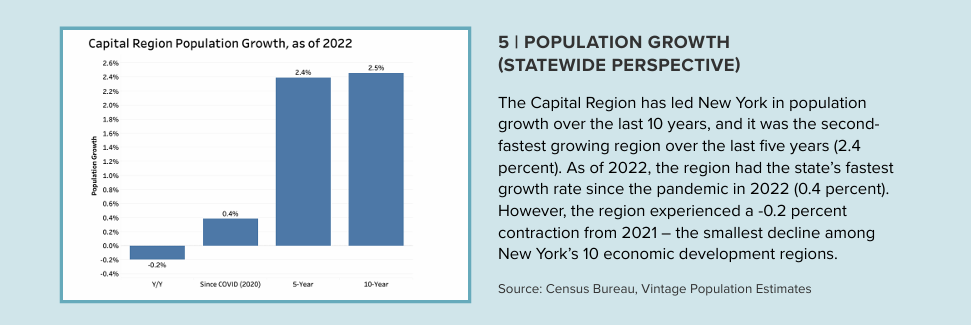
The bank mainly does business in Coshocton County and the immediate area around it. Coshocton is not a fast growing or rich county; the population is about 37,000 people with a median age of 41 years old. Since the county is not fast growing or rich by definition, it is susceptible to deteriorating economic conditions. However, this environment creates a significant competitive advantage to HLFN in the form of lower deposit betas, deep borrower knowledge, and high customer stickiness.
Loan officers often know the borrowers personally which leads to stronger underwriting and higher collateral familiarity. During credit distress, they are able to intervene earlier and do workarounds to avoid credit loss.
Loans and Quality of Loans
The bank’s core loans are 1-4 Residential Mortgage Loans (51.5%) and Nonresidential Real Estate Loans (25.9%), with the remainder on Real Estate Construction & Land, Consumer, and Commercial Loans. Surprisingly, more than 95% of the mortgages they originate are ARMs which means that the whole loan portfolio is variable in nature.
The bank has grown its loan book significantly over the year and has been aggressive with the use of deposits to fuel this growth. Starting in 2022 you can see the surge in the loan book, and it just kept going from there. The L/D stands at 1.14 and has been above 1.0 over the last 13 years, which is quite aggressive to standards. This is what the loan book looks like in the last few years:
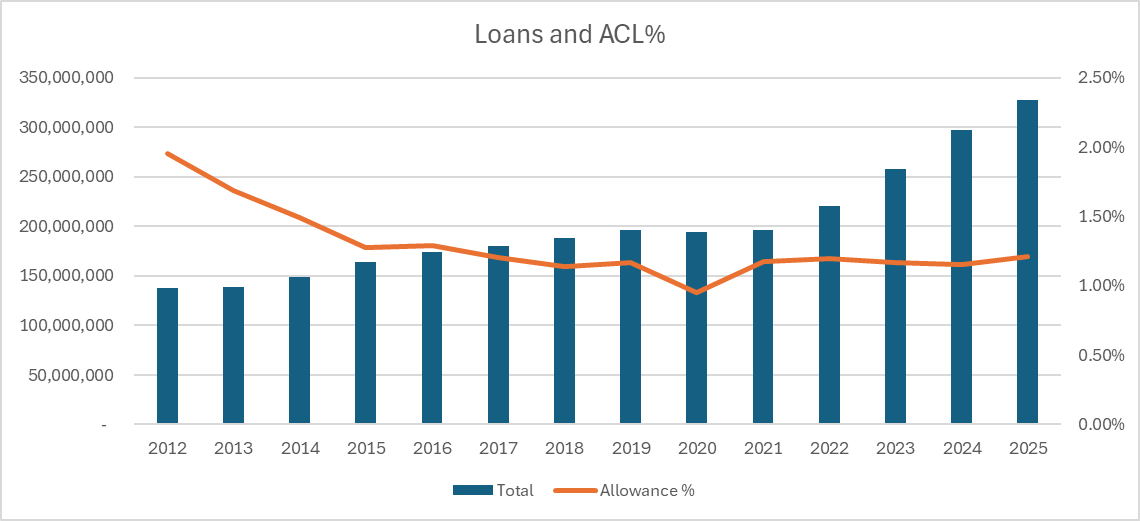
The quality of the loans has been quite good historically speaking. Nonperforming assets (NPA) exceeded 1% of loans only twice in the last 13 years. Delinquency rates (past due 30) have averaged 1.3% but recently spiked to 2.2%, reflecting borrower stress from higher rates.
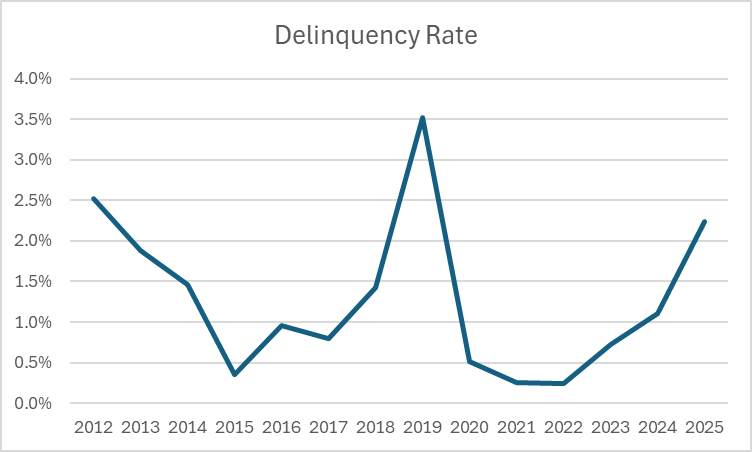
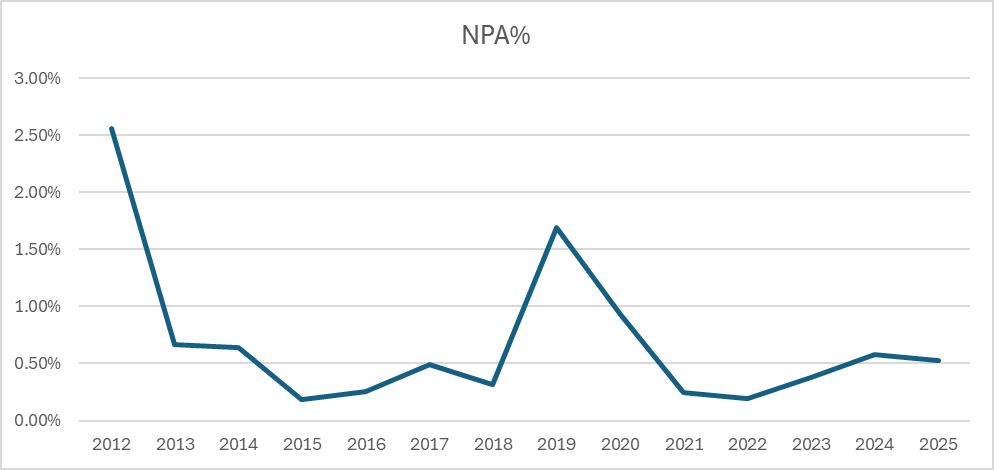
At the same time, they also experienced a substantial jump in substandard loans from $2.8m in 2024 to $10m in 2025. Substandard loans are loans that get reclassified due to evident financial distress from the borrower or decreased collateral value which threatens its repayment. This resulted in four new troubled debt restructurings (TDRs) which means that the bank granted concessions to the borrower to avoid default and help them get back on their feet to repay the loan. These troubled debts reside within 1-4 family real estate and nonresidential real estate, with most of the increase attributable to the latter. Management has been very conservative and has been successful in covering nonperforming loans with their allowance for credit loss (ACL). The current ACL/NPL stands at 230%.
This would be worrying if they did not have sufficient equity buffers to sustain such losses. Their current Tier 1 Capital ratio is 12% vs 4-5% to be considered a “well capitalized” bank. Equity/Assets stand at 12% implying significant equity buffer. Historically, the bank has not experienced credit losses that materially impaired capital.
Deposits
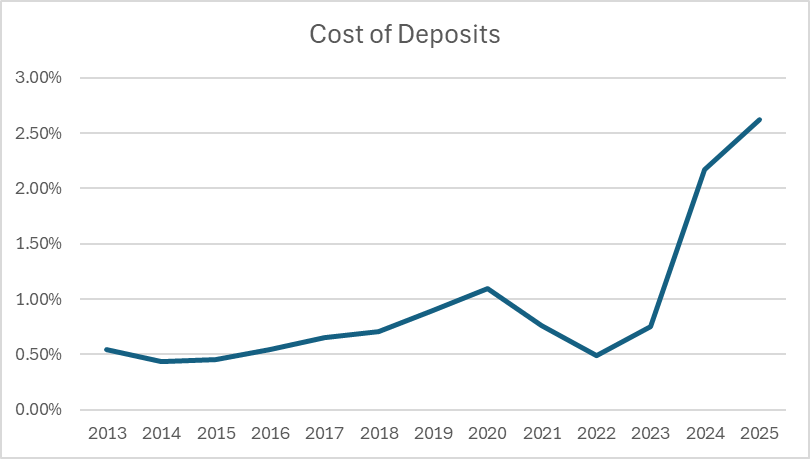
The bank’s core deposit base has been growing consistently over the years, although recently, they have relied more on brokered deposits to support the loan book growth leading to substantially higher deposit costs. Brokered deposits jumped from $6m to nearly $30m from 2024-2025. This seems to be some sort of a short-term strategy rather than long term if we take a look at their history using brokered deposits. If you back out brokered deposits, the core deposit base is still growing.
The deposit base composition looks like this:

The deposit cost trend looks like this:
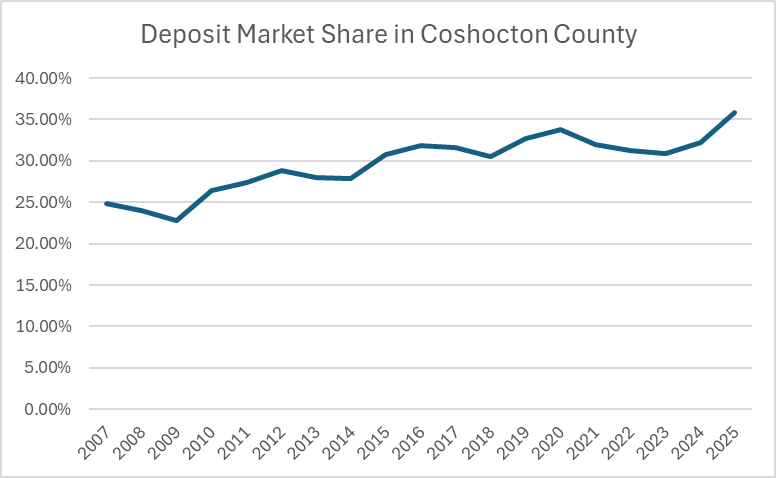
Their deposit market share has trended like this:
Performance
Historically the bank has performed well even through the GFC. They did not experience any loss and were actually profitable. They have become a better bank with a stronger franchise, a bigger loan book, and higher core deposits giving them access to low-cost funding all which have led to consistent growing profitability.
Below is the EPS trend since 05’:
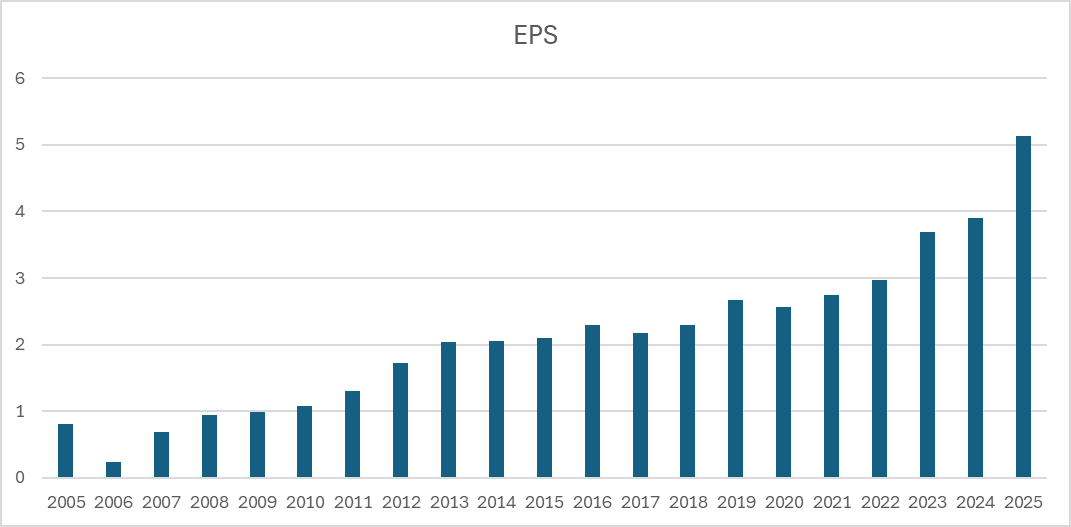
HLFN’s performance in the past 5 years has been stellar. EPS grew from $2.74 to $5.13 in 2025, nearly doubling. This was achieved during an environment in which banks struggled as they saw their NIM under pressure as the yield curve inverted. HLFN is structurally positioned to take advantage of that environment through their predominantly variable loans and significant pricing power. As short term rates rise faster than LT rates, HLFN is able to reprice their liabilities (deposits) slower than peers while at the same time able to reprice assets faster than peers helping them maintain their NIM. That is what we saw during the 2022-2024 period. While deposit costs went up 10x, they were able to increase their loan yields so that the spread did not deviate from long term averages, muting the impact of higher deposit costs. Their NIM did not fall unlike other banks that faced NIM pressures.
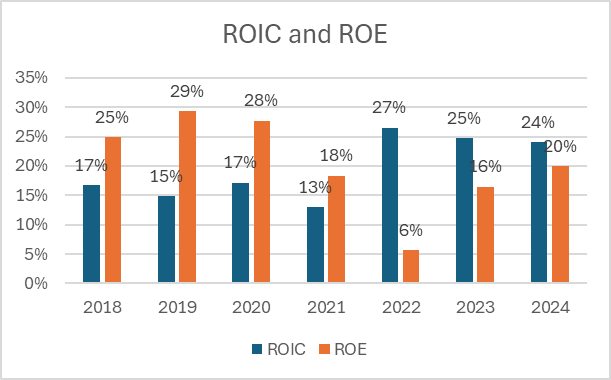
They are currently generating 17.5% ROE without significant leverage. ROA sits at 2.1%. They are a very efficient bank, keeping operating overhead to a minimum which contributes to its above average profitability. Their efficiency ratio stands at 45% which is unheard of. Over the past 13 years, the highest the ratio has been was 54% which is still significantly better than your average community bank with efficiency ratios of 65%+.
With a strong and growing core deposit base, higher pricing power, and growing loan book, I expect the bank to continue growing EPS in the foreseeable future across different rate cycles. HLFN should be reporting around $5.52 eps in FY 26, an increase of 8% from FY 25.
Management
Management has been very under the radar. If you look for a LinkedIn profile, you won’t find anything. I have looked and looked to at least see the face of one of the executives. Finally, I did find a video of the bank’s advertisement on YouTube where they show the CEO of the bank, Kyle Hamilton (Age 53), the son of the chairman. Robert Hamilton is the chairman of the corporation and is 83 years old.
Together, the Hamiltons own approximately 21% of the company, with the rest of the shares owned by HLFN’s ESOP (9%) and other local community members.
Management has been paying dividends, increasing it consistently every year. They recently increased the dividend by 9%.
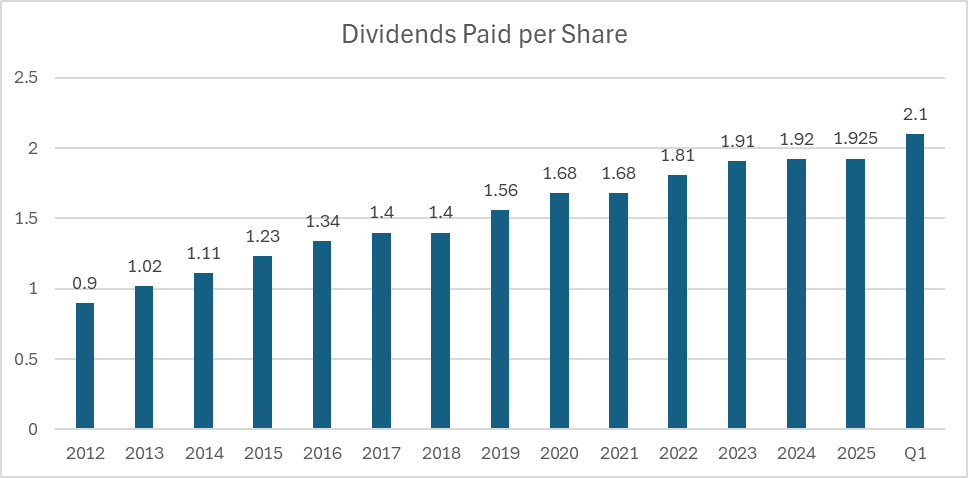
The current dividend yield is 6%. The last time they have bought back shares was in 2013 and they have not diluted shareholders.
Valuation
Despite strong operating performance and long track record of earnings and book value growth, the company is now trading at discounted multiples relative to peers. It seems like investors forgot about the company. No one has written about it in the past 10 years, besides Dave Waters of Alluvial Capital mentioning it post-GFC. I believe this is due to the lack of liquidity (trades only roughly 200 shares daily), the fact that it is traded OTC (no coverage), and their rural footprint.
The company is currently trading at 6.3x FY 26 earnings and 1.1x TBV. This is extremely low for a quality community bank. By comparison, the company traded at 13x earnings pre-covid, and the price has remained flat. Since then, EPS has doubled, deposit base expanded, NIM widened, and ROE improved substantially. At current prices, investors are getting a 15% earnings yield on a well-managed, strong local franchise with significant and growing market share in their respective market.
The bank is able to generate high teens ROE without being substantially levered. It has an equity/asset ratio of roughly 12% which is substantial and provides a significant equity buffer if a loan were to go wrong. Tier 1 Capital ratio stands at around 12%, a ratio significantly above the 4-5% range required to be a “well capitalized” bank. This means that they have levers to put to keep on increasing ROE. They could borrow significantly more money, or buy back significant amounts of stock, or in the most likely scenario, pay a huge dividend to take advantage of the significant buffer they have and to put that standstill equity to work.
I believe HLFN deserves a higher earnings multiple, something closer to peers that reflect the strength of the franchise. A 10x multiple more closely reflects the bank’s quality and yet one can argue it is a conservative multiple as this is not your average community bank. At a price of $55 per share, or a reasonable 10x multiple, this opportunity provides a 2-year return of 58% or a 26% IRR.
Risks
Increasing delinquency rates
Continued overreliance on brokered deposits
*Disclaimer: The information provided in this write-up is for informational and educational purposes only. It should not be considered as financial advice or a recommendation to buy, sell, or hold any security. The author is not a licensed financial advisor and does not purport to provide professional investment advice. The analysis presented is based on the author’s personal research and opinions, which may be subject to errors, omissions, or changes without notice. Any investment decisions should be made after conducting your own thorough research and consulting with a qualified financial professional. The author and any associated parties are not responsible for any financial or other losses incurred based on the information provided in this document. Past performance is not indicative of future results. Always consider your personal financial situation, risk tolerance, and investment objectives before making any investment decisions.