A Quick Intro:
This is my first investment in a Canadian listed company, credit to Joe Raymond who directed it my way and broke my bias. I started looking at it in the summer when I bought some and meant to write this up for a while.
The company is listed in the TSXV trading as IRO.
All figures in USD
Inter Rock Minerals
Trading at 2025 6.6x EBIT, Inter-Rock (IRO) presents a compelling opportunity that seems to be missed by the market. Inter-Rock is able to generate strong returns on invested capital and has a solid path for growth in the dairy feed industry through geographic expansion and R&D marketing to consultants, which are often the decision makers for feed rations.
Snapshot:
Price: $0.83
Diluted S/O: 39.1m
Market Cap: $32.45m
EV: $26.6m
Overview
IRO has two businesses, Papillon Agricultural and Min-AD. They produce, market, and distribute premium specialty nutritional products for the dairy industry. Through Papillon, they produce protein blends, amino acids, and probiotics/prebiotics for both the dairy industry and beef cattle. At Min-AD, they extract and process dolomite and clay products for dairy and beef cattle feed. The specialty dolomite is used as a source of magnesium and calcium and as a rumen acid buffer. Most recently they launched a new clay product used as an anti-caking agent and toxin control.
Papillon
Papillon produces protein blends through toll manufacturing agreements for the dairy industry. They also produce prebiotics and probiotics, and a clostridia control product for dairy cows called Baciflex. This segment accounts for ~88% of revenues, and their protein product line accounts for ~⅔ of Papillon’s gross profits.
Min-AD
Min-AD’s products are distributed mostly by Papillon. Min-AD quarries and processes dolomite and clay products for dairy and beef cattle feed. The specialty dolomite is used as a source of magnesium and calcium and as a rumen acid buffer. It is an essential part of the company now that the transition of Papillon to distribute Min-AD’s product is done. Min-AD accounts for 12% of revenues.
Management
In 2015, Inter-Rock was doing ~$12m in revenues and loss making with their only businesses being Min-AD and Mill Creek (sales to glass industry). Then came 2016 when the Crombie’s acquired Papillon for $5.95m. Take a look at their balance sheet in 2015 and then post-acquisition in 2016:
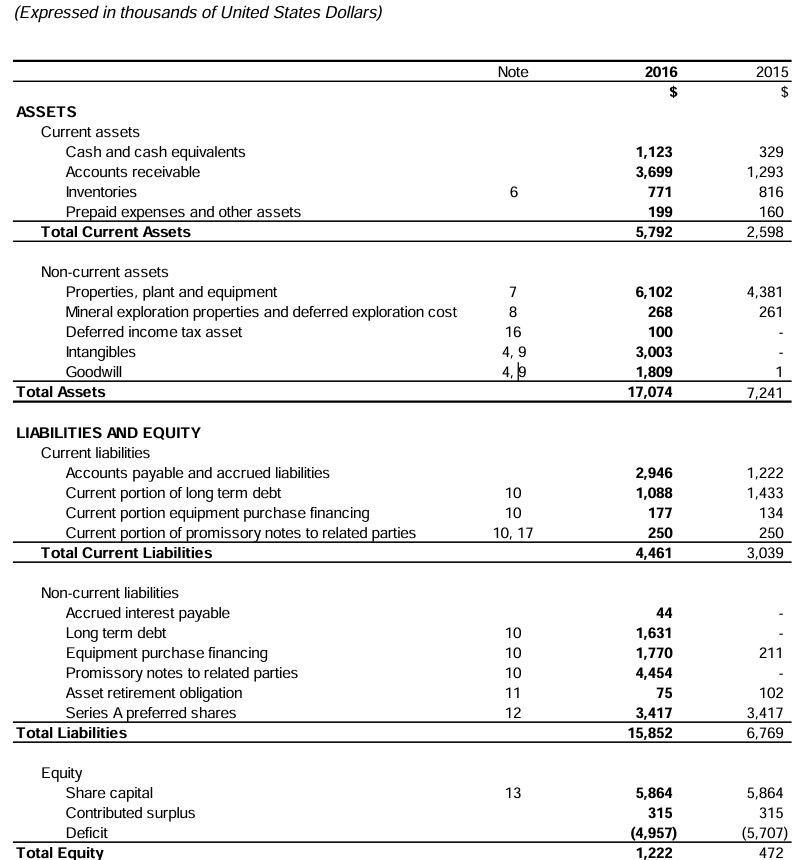
Inter-Rock did not have the cash to acquire Papillon for $5.95m and they only had equity of $472,000. So, they acquired it with debt which included financing from the seller of $3.9m + $500k from the chairman of Inter-Rock + $1.5m from the bank. Papillon was a killer strategic acquisition for them, they could easily use Papillon to increase Min-AD sales on top of what Papillon itself brought, so a lot of synergies here. Post-acquisition, in 2016, revenues were now $30m and generating $1m EBIT.
Fast forward to 2021, Inter-Rock decided to sell Mill Creek for $6.4m to focus exclusively on the animal feed industry after they lost one of their biggest customers. The result of the Papillon acquisition and the sale of Mill Creek allowed the company to go from a net debt position to a net cash position over the years and shareholders’ equity CAGR’d at ~34%.
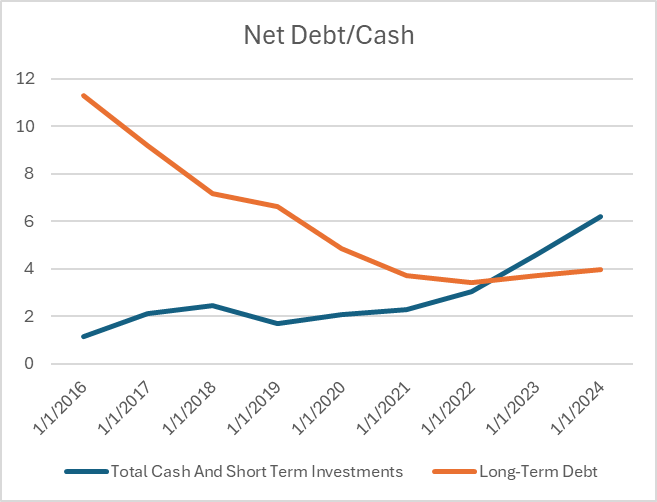
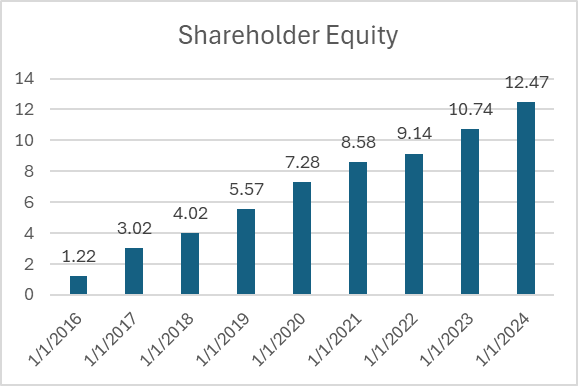
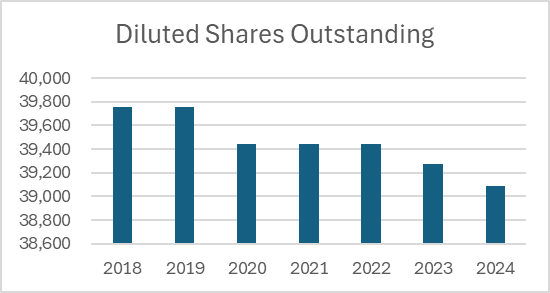
Safe to say management has allocated capital properly, growing the company from $12m in revenues to $100m+ through one acquisition and no share count dilution.
Growth Strategy
I believe the company has a simple and straightforward strategy to keep growing volumes.
They will continue growing through geographic expansion.
The most recent expansion was into the north central region of the US with the addition of a new sales manager that will cover Minnesota, North Dakota, South Dakota, and Iowa in October 2024.
Papillon has good coverage so far, however, there are still some states they have not penetrated fully yet. For example, they have not penetrated California, which is the highest dairy producer in the US and remains a large opportunity to grow volumes while gaining market share in current states.
Papillon’s marketing strategy is tailored to dairy consultants who are often the decision makers at the farms.
The dairy consultants guide the farms to optimize ration feed since feed accounts for approx ~50% of production costs. There has to be a balance between feed costs and output. If a farm is going to pay a higher price for feed ration, it has to be justified in some way, for example by increasing milk output. This is the angle Papillon takes, they anchor R&D to their products which has proved to be a success. From management’s MD&A in Q2 2024: “The Company’s results are due largely to Papillon’s efforts to generate sales in new locations and the promotion of research and development results.”
Their products are on the premium side which is why R&D is so important for them. Due to the cyclical nature of the industry, farms are price sensitive. When milk prices are high, there is more money for premium feed and nutritional products, and when milk prices are low, there is less money for these. However, the dairy industry has transitioned into a more efficient focused industry as evidenced by the stagnant number of dairy cows and milk production still increasing.
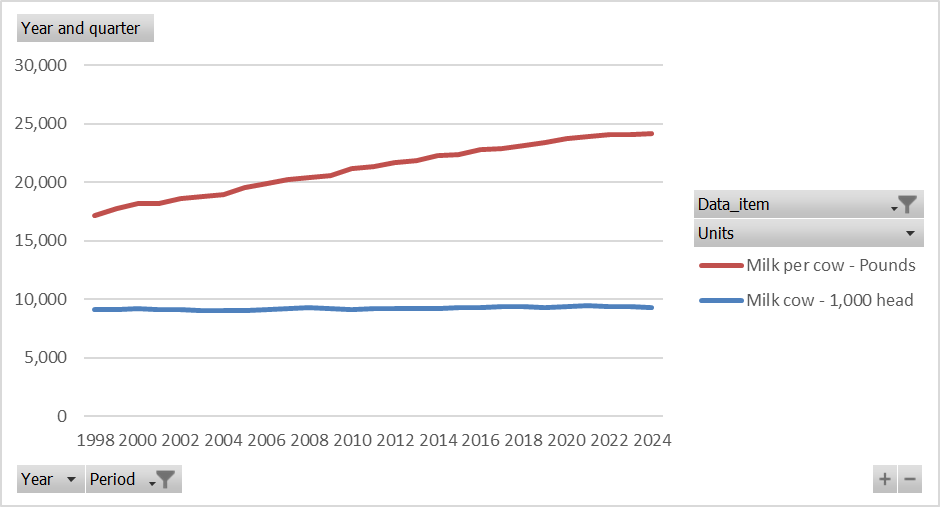
They are more open to spending more on the premium products if it is backed by R&D that shows positive ROI, which is what Papillon does. This makes them more bulletproof, but not entirely, during low milk prices as farms can only sacrifice so much feed quality without milk production taking a big hit. For example, take this testimonial out of Papillon’s website:
“When milk prices go down, many producers will analyze their ration to feed more byproducts and cut ingredients. One they won’t cut is Dairyman’s Edge® PRO. With yeast, live bacteria, and enzymes for the price of a yeast-only product, it delivers a lot more bang for the feed buck.”
Papillon will continue growing protein volumes
Papillon’s protein product line accounts for nearly ⅔ of gross profits, therefore it is essential for the company to grow these volumes and increase profitability. Papillon is able to differentiate themselves vs commoditized by-pass protein sources such as blood meal, feather meal, and soy based by producing blended bypass protein products. This means they diversify and blend together different ingredients to target certain amino-acids cows need, leading to lower feed over income costs (FOIC) and in some cases, total lower costs without a drop in milk production.
For example, in a commercial research report that Papillon released, they showed the variability in price of commoditized blood meal and their blended protein.
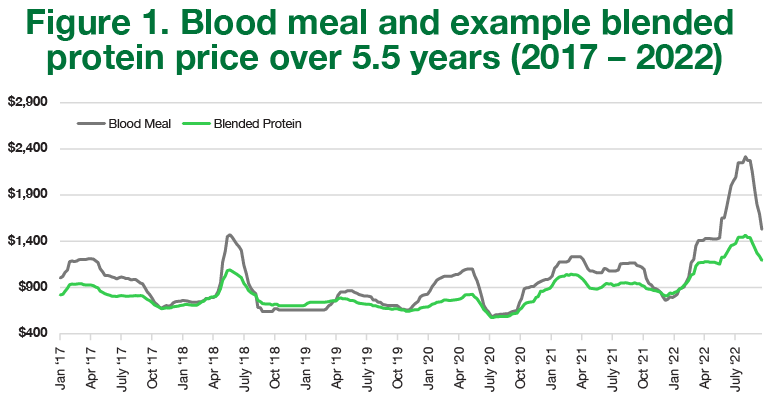
We can see that blended protein price has been continuously lower than blood meal itself. So essentially, dairy farms are getting the same milk output, for much cheaper.
In the case of bypass soy, it is much cheaper than both blended protein and blood meal. However, it is not entirely accurate and it does not paint the whole picture about FOIC.
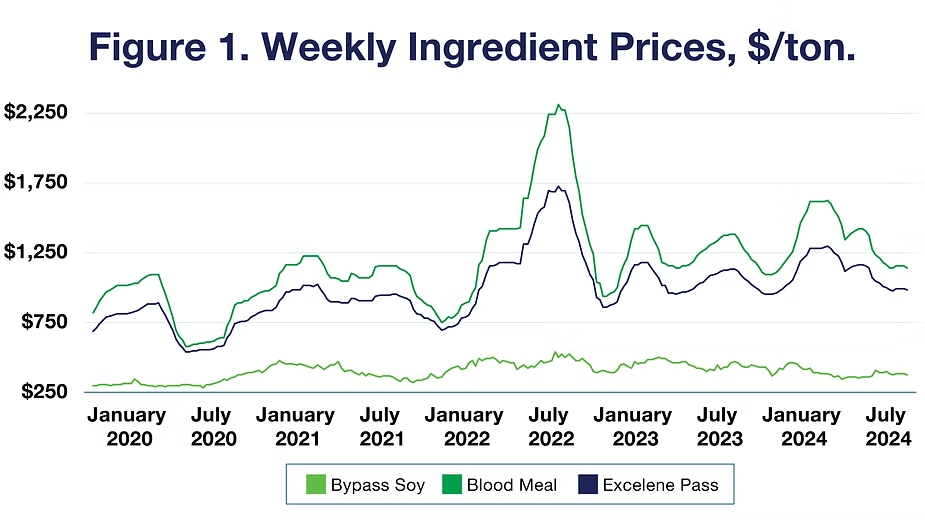
In Papillon’s report they mention: “The contribution to dietary metabolizable protein and amino acids is not equal between these different proteins. The concentration of digestible amino acids in average blood meal and the blended protein example are almost double that of bypass soy and almost triple that of soybean meal. If we correct for that by expressing price on a cost per pound of essential amino acids delivered by the ingredient, the volatility of blood meal remains, but the spread between bypass soy and blood meal is much tighter.”
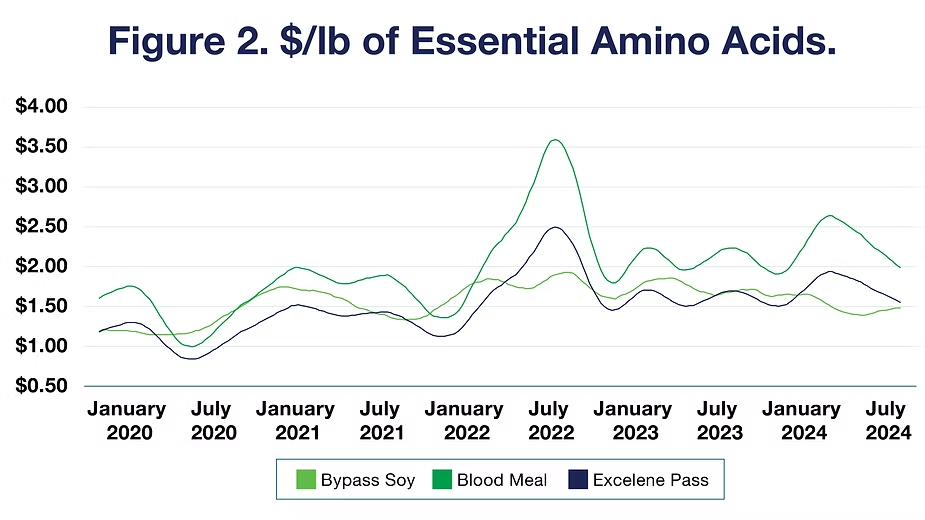
The benefits of blended protein are clear; it delivers double the amino acids than bypass soy for essentially the same price when accounting for how much actually metabolizable protein gets into the cow. Bypass Soy might seem cheaper firsthand, but Papillon makes a great argument on why that is not the case, and it shows their marketing angle when working with consultants.
Their protein line should keep growing volumes due to lower cost, lower FOIC, relationship with consultants, and expansion into current and new geographies. They should also be able to expand margins as they open a new storage facility to store ingredients that allows them to take advantage of price fluctuations. As we can see, blood meal prices can be quite volatile.
Earnings Power
I believe Inter-Rock is underearning compared to its earning power for a few reasons:
Write-downs and special charges
In the last fiscal year, 2024, Inter-Rock wrote down an investment they made in Embion of $435k and recorded a one-time charge of $310k for a patent purchase from a prior year they expensed. These two charges totaled $745k hit to earnings. Backing these out, operating income would have amounted to $3.15m (vs $2.4m reported) compared to $2.7m in 2024, a 16.7% increase in operating profits.
Investments in Growth
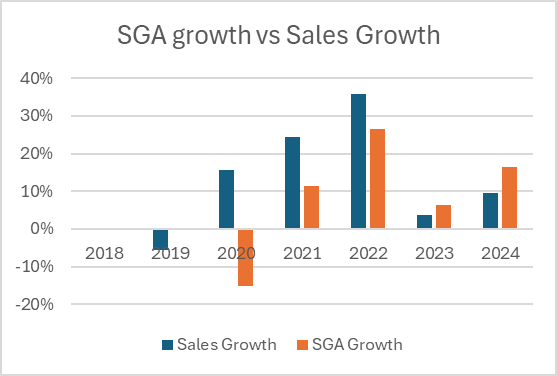
Recently they have expanded their regional sales team, resulting in an unproportionate increase in SG&A compared to revenue growth. However, these investments take time before we see any meaningful revenue growth. Recently, in Q2, we saw revenue growth picking up, and I believe this is due to past investments in geographic expansion. Over the next couple years, I believe we will see operating margins expand as SG&A growth stabilizes and top line growth outpaces SG&A growth.
Strategic synergies and efficiency gains
There are two main efficiency gains that Inter-Rock is going through that are just starting to show up in earnings. In 2024, they completed the transition to Papillon becoming the exclusive distributor of MIN-AD. This is accretive to earnings since Papillon already has a significant distribution footprint across the US dairy regions and can cross-sell the clay products. Additionally, Papillon will do all the marketing, which again is accretive to earnings and creates immediate synergies across both companies as Min-AD just has to focus on production.
The other one is the installment of an automated bagging line at Min-AD. Pretty straight forward, less labor and higher efficiency which flows through the bottom line. This was a majority of 2024 capex spend which totaled $1.2m.
Inter-Rock is currently underearning and still trading below 7x EBIT. I expect to see profitability increase with volume growth and margin expansion, reaching its full earnings power.
Valuation
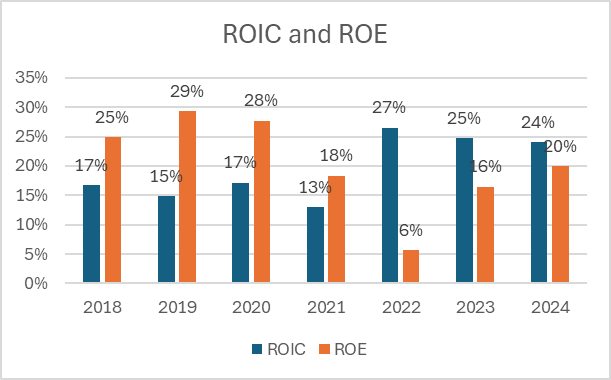
After the recent run up in price (from $0.54 to $0.83), it obviously becomes less attractive. However, it is still cheap, and you would be paying ~6.6x EBIT for a ~20% ROIC business with a long runway for growth. Their strong ROIC comes from their asset-light model at Papillon, using toll manufacturing agreements to manufacture their blends instead of manufacturing it themselves. There is little capital requirement needs and why most of the capex pertains to Min-AD. As long as they can find places to reinvest, they will keep growing earnings at a high rate.
The company is using cash to buy back shares with approximately 6% of shares outstanding to be retired if the full repurchase plan is executed.
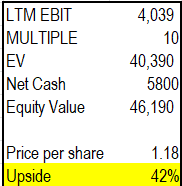
For valuation purposes, I will be using LTM EBIT as we can’t use run rate due to seasonality and would overstate EBIT. 2025 LTM EBIT amounts to ~$4m vs $3.15m (Adjusted 2024), a 27% increase YoY. Assuming a reasonable multiple of 10x LTM EBIT, we come to a 2025 valuation of $1.18/share.
Conclusion
With 20%+ ROIC and long runway for growth through volume increases in by-pass protein sales, geographic expansion, and market share gains by targeting consultants with R&D, a 6.6x 2025 EBIT multiple seems like a steal. I believe their true earnings power will start to show as investments in SG&A bear fruits, and operating leverage kicks in with revenue growth outpacing SG&A.
On the risk side, if milk prices decline materially, premium specialty products might get cut from feed rations which would ultimately affect Inter-Rock. Since their blended bypass protein product is more cost effective than commodity bypass proteins, they might have a cushion for downside.
——————————————————————————————————
Risks
Significant decrease in milk prices
Increases/decreases in ingredient costs (bloodmeal, feathermeal, bonemeal)
Larger competitors entering the feed specialty market
Toll manufacturing agreement fee bump
Family control
*Disclaimer: The information provided in this write-up is for informational and educational purposes only. It should not be considered as financial advice or a recommendation to buy, sell, or hold any security. The author is not a licensed financial advisor and does not purport to provide professional investment advice. The analysis presented is based on the author’s personal research and opinions, which may be subject to errors, omissions, or changes without notice. Any investment decisions should be made after conducting your own thorough research and consulting with a qualified financial professional. The author and any associated parties are not responsible for any financial or other losses incurred based on the information provided in this document. Past performance is not indicative of future results. Always consider your personal financial situation, risk tolerance, and investment objectives before making any investment decisions.


Great work, thank you!
LikeLike