Write Up
Quick Pitch
PXHI is trading at $1.09. I think it is a buy because:
It trades at a cheap multiple of <4x EBIT my 2025 estimates providing us a 25% pre-tax earnings yield
They earn high returns on capital because they are able to turn their inventory quickly, 17x in 2023
They are one of the biggest wholesalers of second-hand phones in the US, data driven, with an extensive buyer network and already scaled, providing some degree of barriers to entry.
It can grow at 10% with industry (until 2027), and in years that inventory is widely available, they can grow at a much faster rate than industry.
Favorable industry tailwinds where demand far exceeds supply. (double edged sword)
They have $0 debt and are buying back shares.
The stock is trading at $1.09, I think it’s worth $2.65. Here is why I think it is worth that; It’s trading at a very low multiple (3.7x EBIT) relative to its growth. I think the company can grow at 10%+ for a couple of years due to strong industry tailwinds with secondary hand phones gaining market share over new phones, and a supply and demand imbalance where demand far exceeds supply. It is an opportunity and a challenge.
They are able to turn inventory like Warren Buffett is able to turn over rocks. Last FY they turned their inventory 17x, resulting in high returns on capital. There is some degree of barriers to entry with scale being extremely important, they can buy directly from carriers allowing them to get the best value out of each phone (only a select few wholesalers are able to buy at the volume they buy), and also have an extensive buyer network instilled in its platform that provides advanced analytics and gives them an informational edge in pricing and velocity. It is tough to start from zero and replicate this, especially in such a competitive industry.
Lastly, they have $0 debt, and management is buying back stock when they have the chance. They have a huge cash balance that serves as a pillow in the case they have to withstand a temporary fall.
PhoneX Holdings
Price: $1.09
Shares Outstanding: 36.22m
Market Cap: $39.5m
Cash: $7m
Debt: $0
EV: $32.5m
Business Overview
PhoneX is in the pre-used mobile device industry. They operate in two models: Trading and Software. The Trading business is the majority of sales, basically just buying wholesale from carriers and big box retailers, cleaning and data wiping the devices, grading them, and finally selling it to resellers. The software business is still being built, and revenues are not disclosed yet. I will not be talking about the software business.
Industry Overview
The industry for secondary phones is relatively new. Before 2014, the industry was not big at all and that was due to basically no supply. Consumers bought new phones, and their old phones were saved in a cabinet inside their house or ended up in landfills. By the end of 2014 and beginning of 2015, the market took a sharp turn and started to form as the carriers began promoting trade-in to attract new customers and retain them in their subscription. This is when a lot of secondhand phones started to circulate, and carriers started taking advantage of the phone’s residual values. The organized secondary market started to form. PhoneX was at that time called “Usell” and it was a platform where consumers sold their old devices for cash. That business model started to decline once the carrier entered the market with their trade-in promo.
They acquired We Sell Cellular in 2015 to deal directly with the carriers, buy in bulk and sell in bulk. However, they were capital constrained. There was a lot of demand for secondhand devices all over the world, but they couldn’t buy more inventory, they didn’t have enough capital. So, they raised money through debt, and they started increasing those inventory levels and revenues expanded at a fast rate as trade-in volumes gained more traction at the carriers. They quickly became one of the few wholesalers that could buy at the volume required to buy directly with carriers, which put them at a cost advantage relative to smaller players.
Today, the industry is a lot more competitive with low margins where in order to survive you have to get your hands on inventory (very hard) and turn it over fast. They have access to supply through the carrier’s trade-in programs. To this day, they are one of the top wholesalers in the industry with an online platform, making it easy to buy in bulk and giving customers the ability to select the devices they want, instead of buying boxes of phones with multiple models that they may not need.
PhoneX’s ability to turn over inventory quickly is impressive. That can be attributed to 2 things; an extensive buyer network (no customer accounts for more than 10% of sales) and supply and demand imbalance, where demand far exceeds supply. This has been the case for a couple years now.
The only limiting factor for their growth is getting their hands on inventory. Most of the phones they sell are iPhones, and it just dominates the secondary market. They recently started expanding into Samsung devices, which brings in healthy demand, however it is mostly iPhone. Supply is principally driven by trade-in volumes, that is, phones traded in with carriers, retailers, etc. If an iPhone launch is weak, so will be the sales for PhoneX as they won’t be able to fulfill demand and margins are going to get squeezed as low supply will cause prices to increase, coupled with increased competition. It is kind of a double-edged sword because if trade-in volumes do well, then there will be more competition driving down margins as well. This was seen in 2023, where margins were affected by increased competition, whereas in 2024 the problem was the weak launch of the iPhone 15 that resulted in low trade-in volumes coupled with increased competition which affected PhoneX’s sales, however, they were able to improve margins.
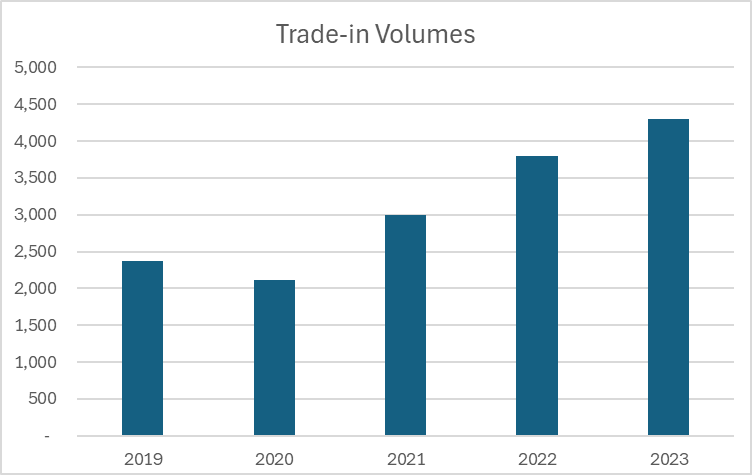
Q4 and 2023 Mobile Trade-In and Upgrade Industry Trends Report
Trade-in volumes have increased substantially over the past couple of years fueled by iPhone releases and continued heavy promotion for trade-in programs from the carriers. As long as this trend keeps growing, which it likely will as it has become the norm when buying new phones, PhoneX will do well because they are dominant in the industry and have the scale and connections, providing some degree of barriers to entry.
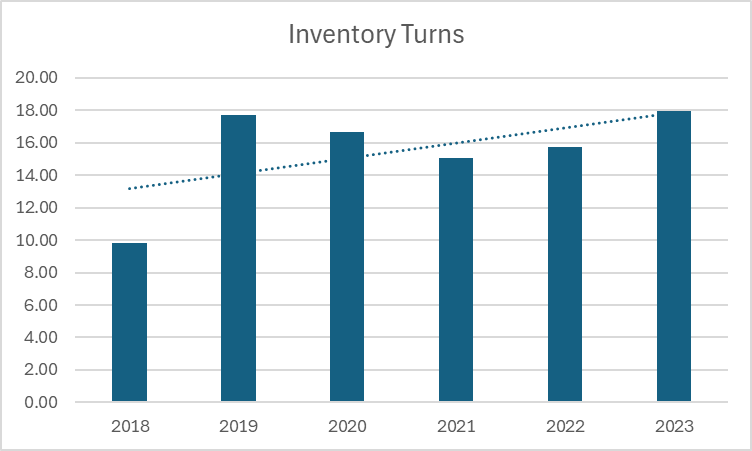
PhoneX is able to turn over inventory like crazy. Again, the only thing stopping them from growing is supply, if they can get their hands on more phones, they will grow at a healthy rate. This is why it is so essential for the iPhone releases to be successful; it will flood the secondary market with supply of older phones, which PhoneX will sell very fast.
Short-term Catalysts
iPhone 16 successful launch with Apple Intelligence
As I mentioned before, trade-in volumes fuel the industry growth. The more trade-ins, the more supply, the more they can sell. Early trade-in volumes captured by “sellcell.com” indicate a 28% trade-in volume growth from prior launch. Additionally, in the Q3 report, the CEO mentioned “management is optimistic that the new iPhone release cycle will drive meaningful economics for the Company in Q4 and in Q1 2025 as consumer excitement around AI capabilities motivates a significant number of consumers to replace older generation devices. Early indications in Q4 suggest that volume will be robust at least in the near term.” All signals point into a strong 2025 with higher trade-in volumes.
Long Term Catalyst
Continued secondary phone market growth
There are many websites and forecasts saying different things but all of them point towards a growing market. IDC mentioned 10% CAGR from 2022-2027. Consumers are wanting cheaper alternatives of the same quality. The answer to that? Pre-used devices or refurbished. It’s just so much cheaper and basically you get the same value.
Consider this, “Used smartphones are now 21% of the total market, compared to just 4% in 2014. 309m were sold last year, versus 1.1bn new smartphones” Used smartphones take 21% of global smartphone sales; Samsung declines as middle market disappears – Chemicals and the Economy.
Used smartphones are becoming more of a mainstream buy. Why waste all that money on a new phone that is the same as an older phone? It’s a complex industry dynamic because we can’t have everyone buying used phones because if not enough people buy new ones, the secondary market will not have supply for those seeking to buy pre-used. We need a perfect balance of new phone buyers and pre-used buyers. I don’t see the industry slowing down any time soon.
Valuation
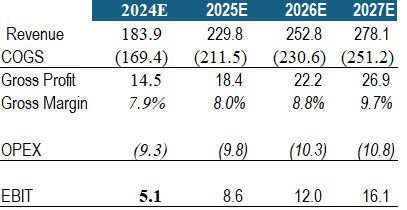
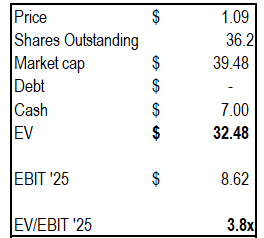
The company is significantly undervalued considering it is trading at my estimate of 3.8x EBIT, growing 20% YoY with favorable industry dynamics. They are buying back shares and positioning the company to be successful in any environment. Their ability to turn inventory quickly allows them to spit out cash every year with minimal capex, leaving substantial cash for shareholders.
Since 2018, the company has grown at a CAGR of 21.5%. Over this period, the nascent industry became an organized, mature industry. Industry is forecasted to grow at a 10% CAGR until 2027. I believe PXHI will be able to grow at a higher rate, making the 10% growth conservative. However, due to uncertainty with the European market, a 10% seems reasonable.
Risks
Average age of smartphones
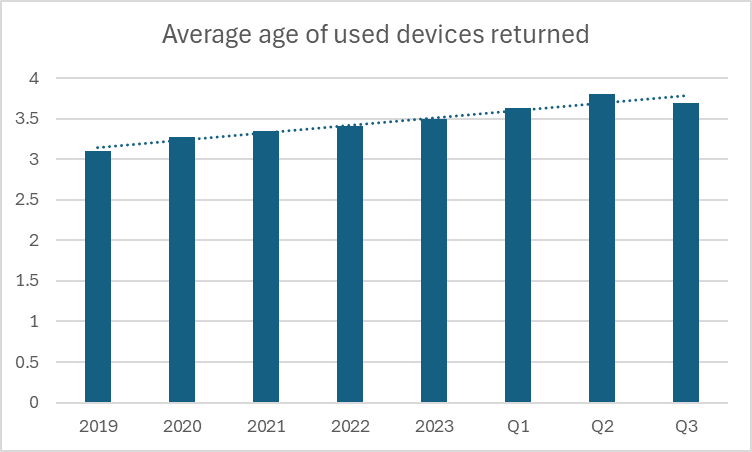
The average age of used smartphones keeps increasing YoY posing a risk, or rather an inconvenience for PXHI. The longer consumers hold onto their phones the less frequent trade-ins. We want continuous movement in trade-ins to keep the secondary market flowing smoothly. At this rate, the best-selling pre-used phone will be three generations behind the new phones. For example, since the iPhone 16 is out now, the best-selling device right now, or the one with the most supply is the iPhone 13. This will carry on to the next risk.
Europe’s USB-C standardization
The European Union stated that every phone that is imported has to have USB-C, otherwise it is illegal. This took effect on December 28, 2024. Europe is one of the biggest importers of secondhand phones in the world, so this would likely have an impact on PXHI, or maybe not. This is a risk I am pretty uncertain of in terms of how it will affect a wholesaler in the US like We Sell Cellular, but considering Europe is one of the main importers, even if they don’t sell directly there, some of their customers do. The market in Europe will be a mess probably until iPhone 18, or 2 more years as by that time, the iPhone 15 which is the earliest iPhone with USB-C will be the one with the most supply, unless iPhone 16 and 17 become big hits.
Apple taking action
Lastly, with secondhand iPhones taking share over new iPhones sold, if it escalates into a bigger share that becomes a problem to Apple, they will likely try to kill the secondary market. How? I do not know but they have the power and resources to. Maybe they will actually expand their trade-in program and scale their refurbishing operations to sell DTC.


Am I reading correctly that they will sell their operating business for an implied 60mm? Do you know if they will be a lot of leakage? Has management expressed what they plan to do with the cash?
LikeLike